
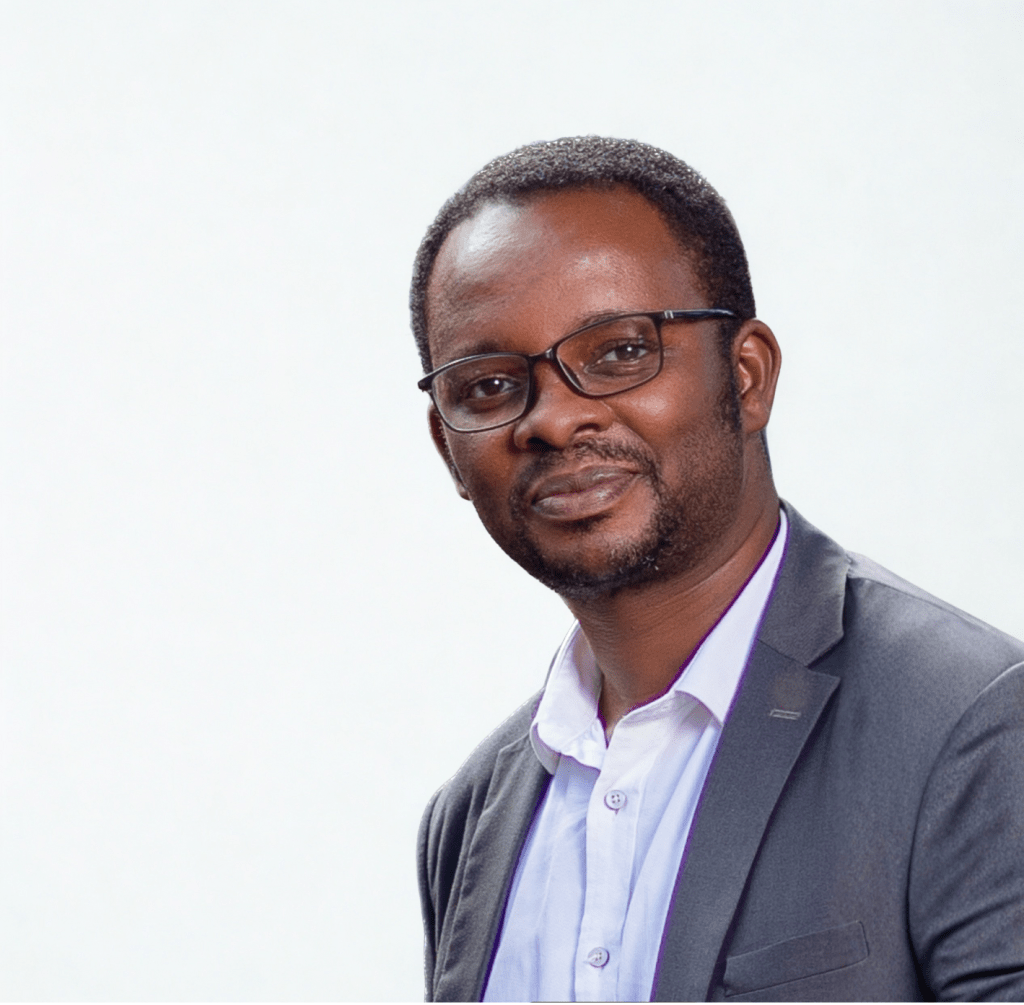
I had the pleasure of speaking with Dr. Vincent Cubaka, a family and community medicine specialist who is an Assistant Professor at the University of Global Health Equity (UGHE), a leading health researcher in Rwanda, and a mentor to many. His story was one of a scientist striving to give voice to the voiceless, whose research centers on strengthening health systems especially in underserved areas to improve access, quality, and equity in care delivery for communities, without discrimination.
Dr. Cubaka’s journey into research began during his medical training, where his passion ignited when he encountered research questions that couldn’t be answered through traditional quantitative methods. “My advisors, my supervisor, told me that this question can’t be answered with surveys, with hypotheses. These are the kind of questions, research questions, that can be answered through qualitative research,” he recalled. What he initially thought would be a one-day course turned into months of intensive study in qualitative research methodologies. This foundation shaped his approach to understanding health systems from the ground up, by focusing on the lived experiences of patients and frontline providers.
Since then, Dr. Cubaka’s research portfolio spans an impressive range of studies focused on primary care and community health from a social medicine lens. He described to me some of the groundbreaking implementation science research projects he’s led, including decentralizing mental health services to primary care, piloting drone delivery of insulin and supplies for type 1 diabetes directly to patients’ homes, using AI-driven mobile health tools to support community health worker follow-up after cesarean sections, and evaluating the scale-up of women’s cancer detection programs. With each example he gave me, I felt a small spark because this is the kind of work that inspired me to pursue a career in public health. Dr. Cubaka’s research moves the needle where it matters, leveraging innovation to transform how care shows up in people’s lives.
The Power of Qualitative Research for Health Systems
While many researchers get excited by numbers and statistical trends, Dr. Cubaka found his calling in qualitative research methods that capture human experiences and perspectives. His approach honours a profound truth: that health systems, despite their macro-level complexity, are fundamentally built and operated by people. “Qualitative research is all about generating new knowledge through observation,” he explained, distinguishing it from quantitative methods which test existing hypotheses.
This people-centered approach has been the basis for Dr. Cubaka’s work on health system strengthening. In his words, qualitative research is particularly powerful for exploring new phenomena and understanding the “why” behind health outcomes. “We have to ask very open-ended questions for people not to validate, for us not to give our ideas to people to validate, but rather to push them to share as much as possible of their [own] ideas, their observations, their experience, their insight,” he emphasized. This methodology allows researchers to understand beyond just what is happening in health systems, and gain insight into why it’s happening and how it affects people.
Navigating Research Challenges Through Creativity
I asked Dr. Cubaka to reflect on the realities of doing research in his setting. He confirmed what several researchers I’ve spoken with in the past have said: that despite Rwanda’s supportive research environment—which Dr. Cubaka described as the outcome of making research a national priority — access to funding remains a persistent challenge. It’s tough finding grants that align exactly with the research that you really want to do, especially in the current context where major funding sources have been cut. However, rather than passively following where the funding leads, Dr. Cubaka advocates for creative approaches that bridge donor interests with community needs.
“I’ve come to learn how to address both the expectations of the funder while you are addressing the community needs in terms of research,” he explained. He shared with me a great example of how he once connected local health priorities (which on their own aren’t attractive for donors) with trending research areas that are more easily “fundable”: he combined post-cesarean care for women with artificial intelligence (AI) technology for early detection of surgical site infections. “That may not be very appealing now for donors, but at the moment they see that you are also finding ways to early diagnose surgical site infection using image… that can be processed through using machine learning… that would be interesting for funders now.”
This creative approach allows researchers to tackle locally relevant health issues while meeting the expectations of international funders who are increasingly interested in AI and digital health technologies. It’s a strategy that requires researchers to think beyond traditional boundaries and find innovative ways to package essential health research within contemporary funding priorities. Dr. Cubaka’s story contains an important lesson: innovation allows researchers to be more proactive in defining their research agenda.
how to do Research for Real Impact
What struck me most about Dr. Cubaka was his staunch commitment to research that creates tangible change in communities. Having worked in implementing organizations as well as academia, he’s observed how research can sometimes become disconnected from real-world impact. “… Especially researchers in academia like me now… we will just do research to advance our career, we just do research to get promoted to the next academic rank, not necessarily research that can be impactful.”
By contrast, when I asked Dr. Cubaka what research he would do with access to unlimited funds and resources, his response revealed his deepest passion: addressing the social factors that hamper equitable access to healthcare. “I would focus on research to better identify and directly address the social determinants of health that fuel inequities. This kind of research linking health outcomes to poverty, housing, food security, education or gender inequalities can be complex and less immediately attractive to funders,” he acknowledged. Yet he sees this as “among the most impactful areas of research if it truly will improve population health.”
I wanted to know what steps Dr. Cubaka takes to ensure that his research will have an impact. Dr. Cubaka emphasized that research impact starts all the way at the beginning, when one selects a research question, and extends through publication and dissemination choices. He advocates for publishing in open-access journals, translating findings into accessible language for different audiences, and actively reaching out to communities, healthcare providers, and policymakers who can act on the research. “At least you can influence the conversation, because they can’t just ignore information you are sharing at the moment they are aware of that information,” he noted.
For young African scholars entering the health research sector, his advice was simple yet profound: “Research is best learned by doing. Take every opportunity to get involved whether in data collection, analysis, proposal writing or dissemination because each experience builds practical skills that no classroom can fully teach.” More importantly, he encourages researchers to remember their social responsibility: “Its ultimate purpose should be to generate knowledge that addresses the most pressing issues facing communities… keeping that sense of social responsibility at the center of one’s research will not only guide better questions but also ensure that the work… has real impact.”
Dr. Cubaka’s approach to research embodies the very equity he studies— building bridges between academic excellence and community impact, ultimately ensuring that his scientific inquiry serves those who need it most. His work demonstrates that the most powerful research emerges when rigorous methodology meets genuine commitment to social justice, creating knowledge that transforms systems and, more importantly, lives.


Leave a Reply